How to Choose the Best Custom Baby Blanket Manufacturer:
A B2B Buyer's Checklist (2026)
B2B Buyer's Checklist (2026) To Choose the Best Baby Blanket Factory
Table of Contents
Quick Answer
Choosing the right custom baby blanket manufacturer requires more than comparing prices. A reliable supplier should offer proven OEM/ODM capabilities, consistent product quality, internationally recognized compliance standards, transparent communication, scalable production capacity, and experience serving global baby brands. Evaluating these factors before placing an order helps reduce sourcing risks and build a long-term manufacturing partnership.
Introduction
Finding the right manufacturing partner is one of the most important decisions for any baby product brand.
Whether you are launching a new private-label collection, expanding an existing product line, or sourcing for a retail chain, your manufacturer will influence every aspect of your business—from product quality and delivery performance to customer satisfaction and brand reputation.
Unlike many consumer products, baby blankets are purchased for infants and young children. Parents expect exceptional softness, safety, durability, and quality. As a result, buyers must evaluate potential manufacturers using a broader set of criteria than price alone.
This guide explains how professional sourcing teams assess manufacturers and provides a practical checklist to help you identify suppliers capable of supporting long-term business growth.
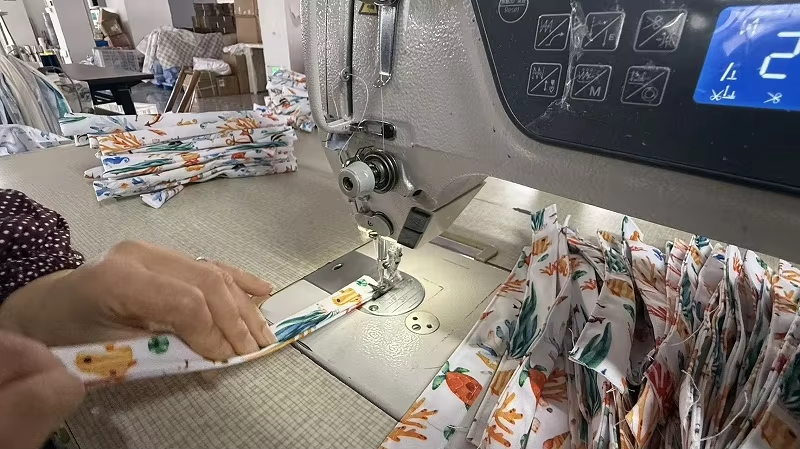
Why Your Manufacturer Matters More Than Your Product?
Many buyers spend months refining product designs while investing only a few days selecting a factory.
In reality, even an outstanding product design can fail if manufacturing quality is inconsistent.
An experienced manufacturer contributes value by:
- Recommending suitable materials for your target market
- Improving product manufacturability without compromising design
- Identifying potential quality issues before production
- Managing compliance with destination-market regulations
- Maintaining stable production schedules
- Supporting future product development
Choosing a manufacturing partner should therefore be viewed as a strategic business decision rather than a purchasing transaction.
1. Evaluate Industry Experience
Not every textile factory specializes in baby products.
Manufacturers with experience in baby blankets understand the unique requirements of this category, including:
- Infant-safe materials
- Soft-touch fabric finishing
- Secure stitching and edge construction
- Age-appropriate product design
- Market-specific compliance requirements
Ask prospective suppliers:
- How many years have you produced baby blankets?
- Which export markets do you primarily serve?
- Do you manufacture for established baby brands?
- What blanket categories do you produce?
A supplier familiar with your target market can often identify issues before they become costly production problems.
2. Assess Product Development Capabilities
A strong manufacturer does more than produce products—it helps improve them.
Look for suppliers that can support:
- Material recommendations
- Fabric sourcing
- Prototype development
- Artwork optimization
- Packaging design
- Cost engineering
- Seasonal trend insights
Manufacturers with experienced product development teams often shorten development cycles while improving product performance.
Expert Insight: Factories that ask detailed questions about your market, customer profile, and retail positioning are often better partners than those who simply provide a quotation.
3. Review Manufacturing Capacity
Production capacity affects both delivery reliability and your ability to scale.
Key questions include:
- What is your monthly production capacity?
- How many sewing lines do you operate?
- How do you manage peak-season demand?
- Can you support repeat orders with consistent lead times?
The goal is not to choose the largest factory but one whose capacity aligns with your growth plans.
4. Verify Quality Control Systems
Quality should be built into every production stage—not inspected only at the end.
Ask manufacturers how they manage:
- Incoming material inspection
- In-process inspections
- Final product inspection
- Defect reporting
- Corrective actions
- Traceability
Request examples of inspection reports or quality documentation where appropriate.
A structured quality management system is generally a stronger indicator of reliability than verbal assurances alone.
5. Confirm Safety and Compliance
Because baby blankets are intended for infants and young children, compliance with relevant safety requirements is essential.
Depending on your target market, discuss:
- Textile safety testing
- Restricted substance requirements
- Fiber content labeling
- Product traceability
- Applicable regulatory standards
A knowledgeable manufacturer should be able to explain which certifications or test reports are relevant for your destination market and production process.
6. Evaluate Communication
Communication problems often become production problems.
During the quotation and sampling stages, observe:
- Response time
- Clarity of answers
- Technical understanding
- Willingness to explain processes
- Transparency when discussing limitations
Reliable suppliers communicate proactively, especially when schedules or specifications need adjustment.
7. Understand MOQ and Flexibility
Minimum order quantity (MOQ) should be evaluated alongside production efficiency.
Instead of asking only for the lowest MOQ, discuss:
- Whether multiple designs can share one production batch
- Available stock fabrics or colors
- Options for phased production
- Repeat-order planning
Flexible solutions can reduce inventory risk without compromising manufacturing efficiency.
8. Compare Quotations Beyond Unit Price
A comprehensive quotation should clearly outline:
- Fabric specifications
- Blanket dimensions
- Decoration methods
- Packaging
- Sampling fees
- Production lead time
- Trade terms (EXW, FOB, CIF, or DDP)
- Payment terms
Comparing quotations line by line provides a more accurate assessment than focusing solely on unit price.
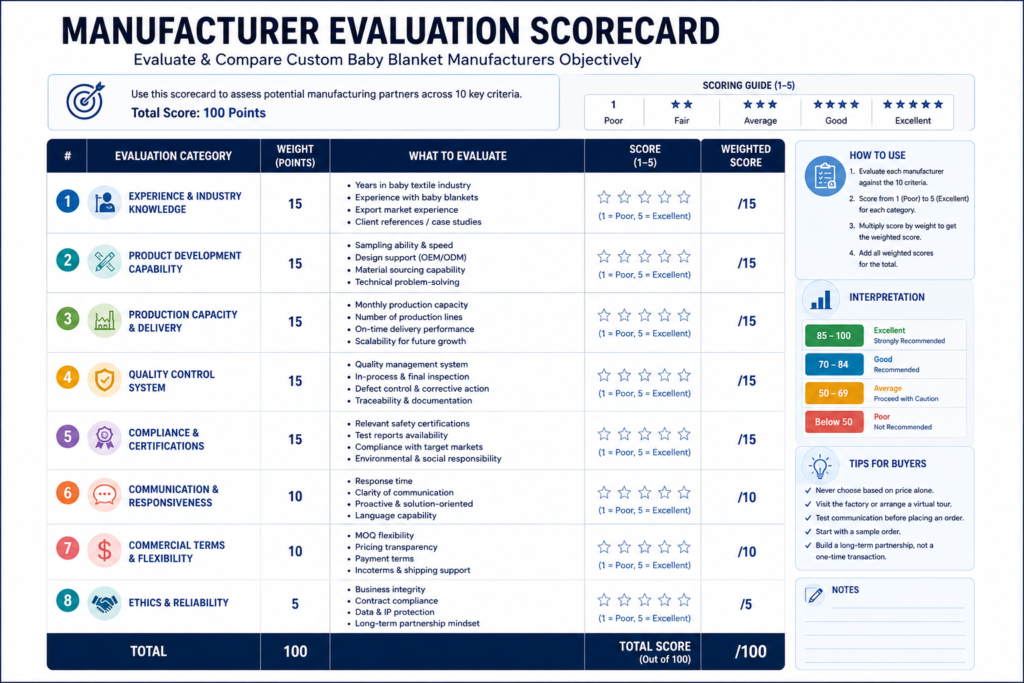
B2B Buyer Checklist
Before selecting a manufacturer, confirm that the supplier can demonstrate:
| Evaluation Area | What to Verify |
|---|---|
| Experience | Proven baby textile manufacturing history |
| Product Development | Sampling and customization support |
| Production | Stable capacity and lead times |
| Quality | Documented inspection procedures |
| Compliance | Relevant certifications or testing capability |
| Communication | Clear, timely, and transparent responses |
| Commercial Terms | Transparent pricing and realistic MOQs |
Use this checklist during supplier evaluations to compare factories consistently.
Common Mistakes Buyers Make
Avoid these common sourcing mistakes:
- Choosing a supplier based solely on the lowest quotation.
- Skipping prototype approval.
- Failing to define product specifications in detail.
- Overlooking packaging requirements.
- Ignoring production schedules during peak seasons.
- Assuming certifications apply to all products without verification.
A structured evaluation process reduces these risks and supports more successful sourcing outcomes.
Conclusion
Selecting the best custom baby blanket manufacturer is about finding a partner capable of supporting your business beyond a single purchase order.
By evaluating experience, product development capabilities, quality systems, compliance knowledge, communication, and commercial transparency, buyers can make more informed sourcing decisions and build partnerships that support long-term growth.
Investing time in supplier evaluation today can reduce operational risks, improve product consistency, and strengthen your brand in an increasingly competitive baby products market.
Frequently Asked Questions
How many manufacturers should I compare before making a decision?
Comparing three to five qualified suppliers is often sufficient to evaluate pricing, capabilities, communication, and overall fit.
Should startups choose OEM or ODM?
Many startups begin with ODM solutions to reduce development costs and shorten launch timelines. As the business grows, transitioning to OEM products can provide greater differentiation.
Is the lowest price always the best choice?
Not necessarily. Factors such as quality consistency, compliance, communication, and production reliability often have a greater long-term impact than a small difference in unit price.
What documents should I request from a manufacturer?
Depending on your project and destination market, you may request product specifications, quality procedures, applicable test reports, production schedules, and relevant compliance documentation.
How important is factory communication?
Effective communication is one of the strongest indicators of a reliable long-term manufacturing partner. Clear communication helps prevent misunderstandings, delays, and quality issues throughout the production process.
Share: